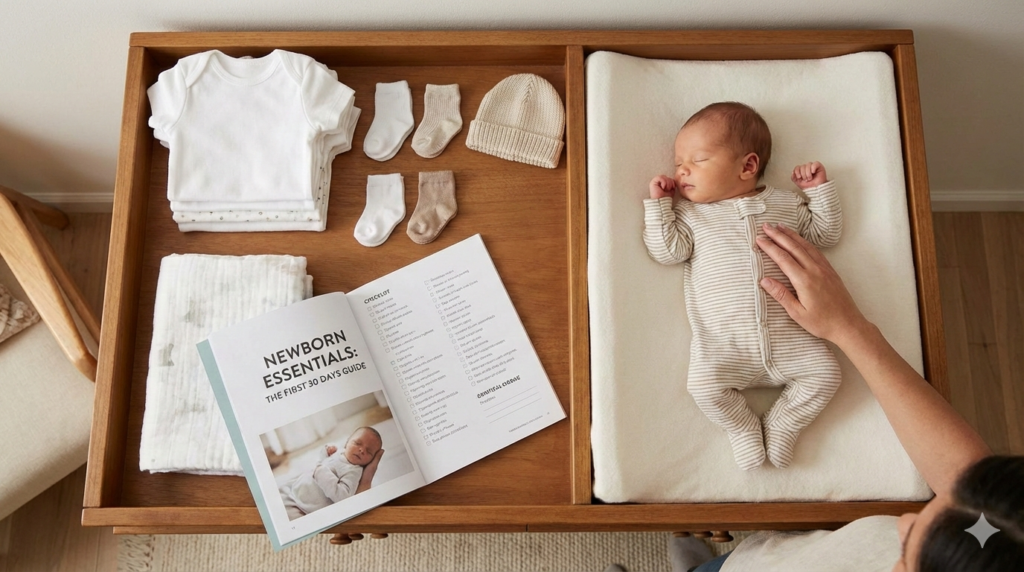
Look, I’m going to save you about $400 and three panic attacks at Target.
When my first kid was born, I had seventeen newborn outfits with matching hats. Know how many she actually wore? Four. The rest sat in a drawer while she lived in the same three sleepers I kept washing on repeat at 2 AM.
Here’s what nobody tells you about newborn baby clothes: your baby doesn’t care if they’re wearing designer onesies or plain white bodysuits. But their skin? Their skin cares a lot.
The 30-Day Reality Check
First-time parents spend an average of $500 on newborn clothes before their baby arrives. Then the baby grows out of newborn sizes in three weeks, and suddenly you’re staring at a closet full of tags-still-on outfits while your kid is wearing the same four pieces on rotation.
Let me break down what actually happens in those first 30 days. Your newborn will:
- Spit up on approximately 60% of their outfits
- Have diaper blowouts that defy physics
- Grow faster than you can process
- Sleep 16-18 hours a day (hopefully)
They won’t be going to brunch. They won’t care about patterns. They definitely won’t remember that adorable outfit you bought for the hospital going-home photo.
What Your Newborn Actually Needs
The Core Wardrobe (7-10 Pieces Maximum)
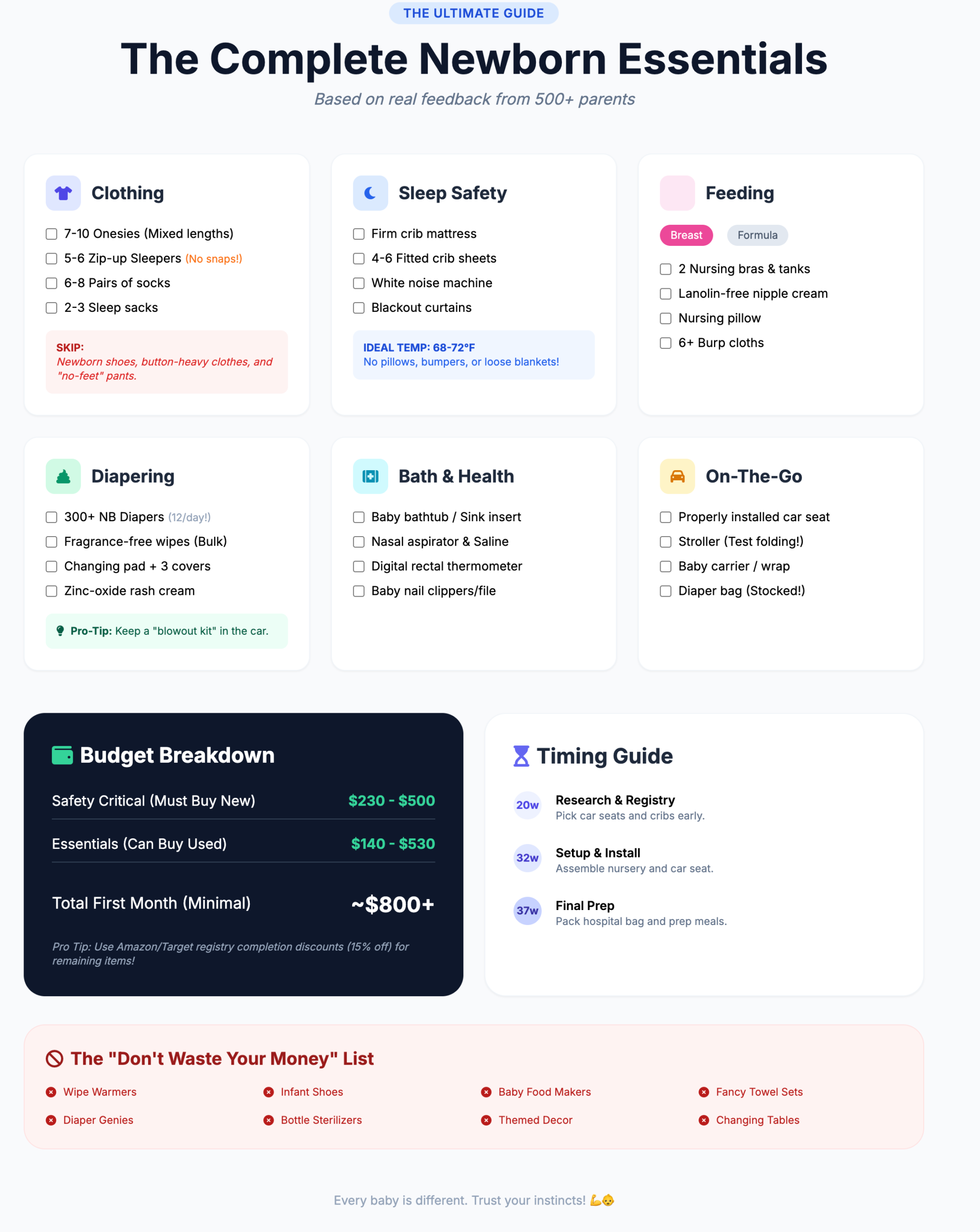
Five to seven zip-up sleepers. Not the snap kind. I repeat: not the snap kind.
At 3 AM when you’re half-asleep and trying to change a diaper, you don’t want to be playing connect-the-dots with twelve tiny snaps. Zippers are faster, easier, and you won’t accidentally snap the wrong snaps and end up with a twisted onesie situation.
Three to five kimono-style bodysuits. These wrap around the side instead of pulling over the head.
Why? Because newborns hate things going over their heads. Also, their umbilical cord stump is still there for the first 1-2 weeks, and traditional onesies can rub against it. Kimono styles avoid that area completely.
Two pairs of footed pants. That’s it. Just two.
Regular pants ride up and expose their belly. Footed pants stay put. Your baby will thank you by crying slightly less.
Six to eight pairs of socks. They vanish. I don’t know where they go. It’s like there’s a sock portal in every washing machine.
The Fabric Actually Matters
Here’s where most baby clothes articles lose the plot. They tell you to buy cute stuff. I’m telling you to buy safe stuff.
Newborn skin is 30% thinner than adult skin. It absorbs whatever touches it. That polyester-blend onesie with the funny slogan? It’s probably treated with formaldehyde to prevent wrinkles during shipping.
Look for these fabric markers:
- 95% cotton or higher (organic if you can swing it)
- GOTS certified (Global Organic Textile Standard)
- Oeko-Tex Standard 100 certified (means it’s tested for harmful chemicals)
Turn the garment inside out. Run your finger along the seams. If they feel rough or scratchy, your baby’s skin will hate them. Newborns can’t tell you their clothes are uncomfortable, so they just cry more.
The clothing industry doesn’t always prioritize baby skin safety over aesthetics. That’s why you need to check labels like you’re investigating a crime scene.
Size Strategy That Actually Works
Buy maybe four newborn-sized items. Maybe.
Most babies wear newborn sizes for 2-4 weeks maximum. Some skip them entirely. My second kid came out at 9 pounds and went straight into 0-3 month sizes.
Here’s the smart distribution:
- 4 newborn pieces (if your baby is predicted under 8 pounds)
- 10-12 pieces in 0-3 month sizes
- Skip 3-6 months for now (you’ll get these as gifts)
Pro tip: babies born in winter need different clothes than summer babies. A winter baby needs long sleeves and warmer fabrics. A summer baby needs breathable, lightweight cotton. Don’t buy a complete wardrobe without considering your due date season.
What You Absolutely Don’t Need
Newborn Shoes (Please Stop)
Babies don’t walk. They kick their shoes off within minutes. You’ll spend more time hunting for lost baby shoes than your child will spend wearing them.
Save your money. Buy socks instead.
Anything With Excessive Buttons
Buttons are decorative torture devices. They take forever to fasten. They pop open at inconvenient times. They’re choking hazards once your baby gets older and starts grabbing everything.
Stick with zippers or snaps (if you must). Better yet, stick with zippers.
The Going-Home Outfit Industrial Complex
You need one nice outfit for photos and the hospital exit. One.
It doesn’t need to cost $60. It doesn’t need to match a hat, blanket, and booties. Your baby will wear it for approximately 45 minutes before you realize it’s impractical and switch back to sleepers.
Scratch Mittens (Controversial Take)
Most pediatricians now recommend against scratch mittens. Babies need to learn hand-eye coordination, and mittens prevent that. Their hands also help regulate body temperature.
Just keep their nails trimmed. File them while they sleep if cutting makes you nervous.
The Real Priorities for Newborn Baby Clothes
Priority #1: Ease of Diaper Changes
You’ll change 10-12 diapers per day in the first month. That’s 300-360 diaper changes. Every zipper, snap, or button multiplies the time spent on this task.
Clothes that open completely from neck to toe are ideal. Avoid anything that only opens partially. You’ll understand why during your first explosive diaper situation.
Priority #2: Temperature Regulation
Newborns can’t regulate their body temperature well. The general rule: dress them in one more layer than you’re wearing.
Room temperature should be 68-72°F. If your baby’s neck feels sweaty, they’re too warm. If their hands and feet are cool but their torso is warm, that’s normal (babies have poor circulation to extremities).
Sleep sacks are safer than blankets. Get two: one in 0.5 TOG for warmer weather, one in 2.5 TOG for cooler weather. TOG measures thermal resistance. Higher TOG = warmer.
Priority #3: Skin Safety Over Everything
According to the American Academy of Pediatrics, newborn skin is more permeable and sensitive than adult skin. Chemical exposure through clothing is a legitimate concern.
Wash all new clothes before your baby wears them. Use fragrance-free, dye-free detergent designed for babies. Skip fabric softener entirely (it coats fabrics with chemicals and reduces absorbency).
Check for:
- Rough seams (should be flat or external)
- Tight elastic (can restrict circulation)
- Loose threads (choking hazard)
- Small decorative elements (can detach and become choking hazards)
The First 30 Days: A Realistic Timeline
Days 1-7: Your baby will likely wear kimono-style bodysuits because of the umbilical cord stump. You’ll go through 2-3 outfits per day due to spit-up and diaper incidents.
Days 8-21: The cord stump falls off. You can transition to regular onesies if you want, but honestly, those kimono styles are so easy you might stick with them. You’re still washing clothes constantly.
Days 22-30: You’ve found your rhythm. You have 3-4 favorite pieces that you wash on rotation. Everything else sits in the drawer. You start eyeing 0-3 month sizes because your baby is growing ridiculously fast.
This is normal. Every parent goes through this.
The Minimalist Starter Pack
If you want to cut through all the noise, here’s the absolute starter pack:
- 5 zip-up sleepers (0-3 month size)
- 3 kimono bodysuits (newborn or 0-3 month)
- 2 pairs of footed pants
- 6 pairs of socks
- 2 sleep sacks (one light, one medium weight)
- 1 going-home outfit
Total cost if you’re smart: $150-200. You can buy the rest as needed once your baby arrives and you see what actually works for your lifestyle.
Common Questions Parents Actually Ask
“Should I buy organic?” If you can afford it, yes. Babies wear these clothes 24/7 against sensitive skin. Organic cotton hasn’t been treated with pesticides. But if budget is tight, prioritize buying fewer pieces of better quality over quantity.
“What about hand-me-downs?” Absolutely use them. Check that elastic isn’t worn out and fabrics haven’t become rough from repeated washing. Avoid anything with fading stains (the stains themselves are fine, but heavy staining often means harsh chemical treatments to remove them).
“Do boys and girls need different clothes?” No. Babies need comfortable, practical clothes. The gender-specific baby clothes market is mostly marketing. Buy what works, regardless of color.
The Bottom Line
Your newborn needs comfortable, safe, easy-to-change clothes in appropriate sizes for about 30 days before they outgrow everything. That’s it. That’s the article.
Everything else is marketing designed to make you think you need seventeen matching outfits, coordinating hats, and a wardrobe that rivals your own.
Save your money. Your baby will be just as happy (probably happier) in simple, soft, practical clothes that make your life easier during those exhausting first weeks.
Save this checklist for later. Screenshot it. Bookmark it. Send it to other sleep-deprived parents who are standing in the baby section at 9 PM, overwhelmed by choices.
Because the truth is: less is more. Your baby needs your presence, not your purchases. The perfect newborn wardrobe is the one that makes caring for them easier, not the one that looks best on Instagram.
Now go buy five sleepers and call it a day. Your future self will thank you.